0

The following is a guest post written by Chris and Anja, volunteers with Bahia Aventuras, about their Corcovado National Park Tour. Thanks Chris and Anja for contributing.

As I am really passionate about animals (especially monkeys!) I decided to visit Corcovado National Park, which is famous for its density of species. Some days earlier to my trip I already had joined an amazing snorkeling tour offered by Bahía Aventuras, so I knew where to turn to. And again they didn’t dissapoint me at all!
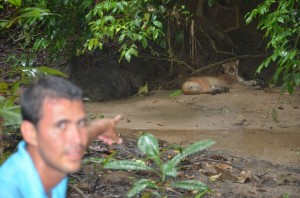
We drove to Corcovado by boat and went hiking for about 4 hours. Because it was raining the night before, the trail was a little bit muddy (hint: bring your hiking shoes, not your sandals!). Our guide had deep knowledge about both flora and fauna of the jungle and showed us every animal we discovered on a folder with pictures as well. We saw everything from howler monkeys and groups of spider monkeys to snakes, frogs to all kinds of eagels and hummingbirds down to fireflies, leafcutter ants and other things. Pretty much everything you would expect of a jungle. After the hike I was really exhausted, but the included meal at the park was excellent and more than enough for everyone. Unfortunately the weather changed on our way back and we got into a heavy rainstorm, leaving us soaked on the boat (hint #2: bring your raincoat, you never know!).

Nevertheless the whole trip was an experience I wouldn’t want to have missed!

Continue Reading

0

The following is a guest post written by Chris and Anja, volunteers with Bahia Aventuras, about the Cano Island Snorkel Tour. Thanks Chris and Anja for contributing.

Me and my girlfriend booked a snorkeling tour in December. We had a 1,5h long boat trip to Isla de Caño, south to the Marino Ballena National Park. The trip started right within the National Park, which turned out to be amazing: dolphins decided to accompany our boat and we even saw two humpback whales! Our guide explained everything about them and was really helpful. In total, we visited three snorkeling spots where we could explore the reefs in front of Isla de Caño. The water was quite cold that day, but we saw lots of different fish species and even a sea turtle. Our group also visited the island itself for lunch (typical costa rican arroz con pollo, pasta salad, sandwiches, fresh fruits – yummy!) and relaxing at the beach.

Overall the trip was informative, well organized and is absolutely recommendable!

Continue Reading

0

Some of the best Costa Rica snorkeling happens to be a short one hour boat cruise from the beautiful towns of Bahia-Uvita, Osa.  The magical place to snorkel is called Cano Island and it offers visitors pristine crystal clear waters to discover mother oceans mysteries.  Explore the world below the oceans surface and become enchanted forever.

YouTube Preview Image

Continue Reading

Cruise with us!

Published on 17 March 2010 by bahiaaventuras in Costa Rica Tours

0

The Bahia Aventuras I is a 2008 boat design complimented with a 2008 Suzuki 250HP that allows for comfort and style when navigating. It has 14 individual seats and accomadates any of our tours; a 4 person Private Sportfishing Tour to a 14-passenger Bahia Aventuras Combo Tour. The boat is great for whale watching, snorkeling trips to Cano Island, nature tours to Corcovado National Park, sport fishing, bird watching tours through the mangroves, dolphin encounters, and just cruising the beautiful Marino Ballena National Park in Uvita-Bahia Ballena, located in the south pacific near the osa peninsula of Costa Rica.

YouTube Preview Image

Continue Reading

0
Baird’s TAPIR
Baird’s Tapir (Tapirus bairdii) is a species of tapir that is native to Central America and northern South America. It is one of three Latin American species of tapir.
It is a large browsing mammal, roughly pig-like in shape, with a short, prehensile snout. Tapirs inhabit jungle and forest regions of South America, Central America, and Southeast Asia and in Costa Rica can be found in the tropical rainforest of Corcovado National Park, often times near the river banks and ocean shores.  . There are four species of Tapirs, being the Brazilian tapir, the Malayan tapir, Baird’s tapir and the mountain tapir. All four species of tapir are classified as endangered or vulnerable. Their closest relatives are the other odd-toed ungulates, including horses and rhinoceroses.
The Baird’s Tapir has a distinctive cream-colored marking on its face and throat and a dark spot on each cheek, behind and below the eye. The rest of its hair is dark brown or grayish-brown. The animal is the largest of the three American species and, in fact, the largest land mammal found in the wild from Mexico to South America. Baird’s Tapirs usually grow to 2 metres (6.6 ft) in length and 1.2 metres (3.9 ft) in height, and adults weigh 240–400 kilograms (530–880 lb). Like the other species of tapir, they have small stubby tails and long, flexible proboscises. They have four toes on each front foot and three toes on each back foot.
The gestation period is approximately 400 days, after which one offspring is born (multiple births are extremely rare). The babies, as with all species of tapir, have reddish-brown hair with white spots and stripes, a camouflage which affords them excellent protection in the dappled light of the forest. This pattern eventually fades into the adult coloration. For the first week of their lives, infant Baird’s Tapirs are hidden in secluded locations while their mothers forage for food and return periodically to nurse them, but after this time, the young follow their mothers on feeding expeditions. At three weeks of age, the young are able to swim. Weaning occurs after one year, and sexual maturity is usually reached six to twelve months later. Baird’s Tapirs can live for over thirty years.

Baird’s Tapir (Tapirus bairdii) is a species of tapir that is native to Central America and northern South America. It is one of three Latin American species of tapir.

YouTube Preview Image

It is a large browsing mammal, roughly pig-like in shape, with a short, prehensile snout. Tapirs inhabit jungle and forest regions of South America, Central America, and Southeast Asia and in Costa Rica can be found in the tropical rainforest of Corcovado National Park, often times near the river banks and ocean shores.  . There are four species of Tapirs, being the Brazilian tapir, the Malayan tapir, Baird’s tapir and the mountain tapir. All four species of tapir are classified as endangered or vulnerable. Their closest relatives are the other odd-toed ungulates, including horses and rhinoceroses.

The Baird’s Tapir has a distinctive cream-colored marking on its face and throat and a dark spot on each cheek, behind and below the eye. The rest of its hair is dark brown or grayish-brown. The animal is the largest of the three American species and, in fact, the largest land mammal found in the wild from Mexico to South America. Baird’s Tapirs usually grow to 2 metres (6.6 ft) in length and 1.2 metres (3.9 ft) in height, and adults weigh 240–400 kilograms (530–880 lb). Like the other species of tapir, they have small stubby tails and long, flexible proboscises. They have four toes on each front foot and three toes on each back foot.

The gestation period is approximately 400 days, after which one offspring is born (multiple births are extremely rare). The babies, as with all species of tapir, have reddish-brown hair with white spots and stripes, a camouflage which affords them excellent protection in the dappled light of the forest. This pattern eventually fades into the adult coloration. For the first week of their lives, infant Baird’s Tapirs are hidden in secluded locations while their mothers forage for food and return periodically to nurse them, but after this time, the young follow their mothers on feeding expeditions. At three weeks of age, the young are able to swim. Weaning occurs after one year, and sexual maturity is usually reached six to twelve months later. Baird’s Tapirs can live for over thirty years.

Continue Reading

0
Green and black poison dart frog
The green and black poison dart frog, (Dendrobates auratus) is a brightly-colored member of the order Anura and is a native to Costa Rica.  It is commonly seen in the Osa Peninsula and the Corcovado National park during the Bahia Aventuras Corcovado Tour.  They are usually found on the floor of the rain forest and prefer locations near small streams or pools.
The adults are approximately 4 cm long and have a fused head and trunk with no tail.  Another important physical characteristic is the poison glands located throughout the surface of their body. Their bright colors are believed to encourage predators with color vision to avoid the frogs. The boldly contrasting patterns may be aposematic to predators that lack color vision, although this has not been proven.  They are diurnal, and are seldom still during the day, constantly searching for food and taking care of young.  They also have distinctive hopping motions.

The green and black poison dart frog, (Dendrobates auratus) is a brightly-colored member of the order Anura and is a native to Costa Rica.  It is commonly seen in the Osa Peninsula and the Corcovado National park during the Bahia Aventuras Corcovado Tour.  They are usually found on the floor of the rain forest and prefer locations near small streams or pools.

YouTube Preview Image

The adults are approximately 4 cm long and have a fused head and trunk with no tail.  Another important physical characteristic is the poison glands located throughout the surface of their body. Their bright colors are believed to encourage predators with color vision to avoid the frogs. The boldly contrasting patterns may be aposematic to predators that lack color vision, although this has not been proven.  They are diurnal, and are seldom still during the day, constantly searching for food and taking care of young.  They also have distinctive hopping motions.

Continue Reading

0
The Ant eater (Myrmecophaga tridactyla), often reffered to in spanish as Oso hormiguero, litrally, “anteating bear”, is an animal measuring up to 2.4 meters (8 feet) in length, excluding the tail, and up to 1.2 meter (4 foot) in height at the shoulder. It has a long, thin head with a large bushy tail. Its color is gray, with a broad black band, bordered with white, starting on the chest, and passing over the shoulder.  Giant Anteaters are sometimes mistaken for bears because of their claws and bushy fur. It is also a very solitary animal and very easy to observe during the Corcovado National Park Tour.
Its food mainly consists of termites, which it obtains by opening nests with its powerful sharp claws. As the insects swarm to the damaged part of their dwelling, it draws them into its mouth by means of its long, flexible, rapidly moving tongue covered with sticky saliva. Their tongue can be flicked up to 150-160 times or more per minute. A full-grown giant Anteater eats upwards of 30,000 ants and termites a day.They also have small spikes on their tongue that help keep the ants and other insects on the tongue while they get swept into the anteaters mouth.
The Ant eaters frequent the low swampy savannas, along the banks of rivers, and the depths of the humid forests in the Corcovado National Park.
The two Anteaters of the genus Tamandua, the Southern Tamandua (Tamandua tetradactyla) and the Northern Tamandua (Tamandua mexicana), are much smaller than the Giant Anteater, and differ essentially from it in their habits, being mainly arboreal. They inhabit the dense primeval forests of South and Central America. The usual colour is yellowish-white, with a broad black lateral band, covering nearly the whole of the side of the body.

The Ant eater (Myrmecophaga tridactyla), often reffered to in spanish as Oso hormiguero, litrally, “anteating bear”, is an animal measuring up to 2.4 meters (8 feet) in length, excluding the tail, and up to 1.2 meter (4 foot) in height at the shoulder. It has a long, thin head with a large bushy tail. Its color is gray, with a broad black band, bordered with white, starting on the chest, and passing over the shoulder.  Giant Anteaters are sometimes mistaken for bears because of their claws and bushy fur. It is also a very solitary animal and very easy to observe during the Corcovado National Park Tour.

YouTube Preview Image

Its food mainly consists of termites, which it obtains by opening nests with its powerful sharp claws. As the insects swarm to the damaged part of their dwelling, it draws them into its mouth by means of its long, flexible, rapidly moving tongue covered with sticky saliva. Their tongue can be flicked up to 150-160 times or more per minute. A full-grown giant Anteater eats upwards of 30,000 ants and termites a day.They also have small spikes on their tongue that help keep the ants and other insects on the tongue while they get swept into the anteaters mouth.

The Ant eaters frequent the low swampy savannas, along the banks of rivers, and the depths of the humid forests in the Corcovado National Park.

The two Anteaters of the genus Tamandua, the Southern Tamandua (Tamandua tetradactyla) and the Northern Tamandua (Tamandua mexicana), are much smaller than the Giant Anteater, and differ essentially from it in their habits, being mainly arboreal. They inhabit the dense primeval forests of South and Central America. The usual colour is yellowish-white, with a broad black lateral band, covering nearly the whole of the side of the body.

Continue Reading

0
PIZOTE
The White-nosed Coati (Nasua narica), also known as the Pizote, is a species of coati and a member of the Procyonidae (raccoon family) and is commonly seen in Costa Rica.  With Bahia Aventuras you can see the White-nosed Coati during your Corcovado National Park full day tour.
White-nosed Coatis inhabit wooded areas (dry and moist forests) of the Osa Peninsula and Corcovado Park.  They are found at any altitude from sea level to 3,500 m (11,000 ft).  They are omnivores, preferring small vertebrates, fruits, carrion, insects, and eggs. They can climb trees easily, where the tail is used for balance, but they are most often on the ground foraging. Their predators include boas, raptors and  hunting cats like the jaguar and puma that inhabit the Corcovado National. They readily adapt to human presence; like Raccoons, they will raid campsites and trash receptacles. They can be domesticated easily, and have been verified to be quite intelligent.
White-nosed Coatis are primarily diurnal, retiring during the night to a specific tree and descending at dawn to begin their daily search for food.  Adult males are solitary, but females and sexually immature males form social groups. They use many vocal signals to communicate with one another, and on our tours you might hear them.  They also spend time grooming themselves and each other with their teeth and claws.The White-nosed Coati (Nasua narica), also known as the Pizote, is a species of coati and a member of the Procyonidae (raccoon family) and is commonly seen in Costa Rica.  With Bahia Aventuras you can see the White-nosed Coati during your Corcovado National Park full day tour.

The White-nosed Coati (Nasua narica), also known as the Pizote, is a species of coati and a member of the Procyonidae (raccoon family) and is commonly seen in Costa Rica.  With Bahia Aventuras you can see the White-nosed Coati during your Corcovado National Park full day tour.

YouTube Preview Image

White-nosed Coatis inhabit wooded areas (dry and moist forests) of the Osa Peninsula and Corcovado Park.  They are found at any altitude from sea level to 3,500 m (11,000 ft).  They are omnivores, preferring small vertebrates, fruits, carrion, insects, and eggs. They can climb trees easily, where the tail is used for balance, but they are most often on the ground foraging. Their predators include boas, raptors and  hunting cats like the jaguar and puma that inhabit the Corcovado National. They readily adapt to human presence; like Raccoons, they will raid campsites and trash receptacles. They can be domesticated easily, and have been verified to be quite intelligent.

White-nosed Coatis are primarily diurnal, retiring during the night to a specific tree and descending at dawn to begin their daily search for food.  Adult males are solitary, but females and sexually immature males form social groups. They use many vocal signals to communicate with one another, and on our tours you might hear them.  They also spend time grooming themselves and each other with their teeth and claws.

Continue Reading

0

Scientists believe that early whales actually walked the earth. The theory, supported by recent fossil finds in the foothills of the Himalayas, is that about 53.5 million years ago, whales were amphibious. They originated as land mammals, and gradually ventured into the water in search of food. They fed on fresh and saltwater fish. Eventually, they lost their legs and nostrils, and became the creatures we know today.
Marine mammals such as whales spend their entire lives at sea. So how can they sleep and not drown? Scientists have observed two basic methods of sleeping: They either rest quietly in the water, vertically or horizontally, or sleep while swimming slowly next to another animal. Young whales rest, eat, and sleep while their mother swims, towing them along in her slipstream. This is called “echelon swimming.” At these times, the mother will also sleep on the move. In fact, she cannot stop swimming for the first several weeks of a newborn’s life. If she does for any length of time, the calf will begin to sink; it is not born with enough body fat or blubber to float easily.
Killer whales are the largest dolphins. They get their name because they sometimes eat other, larger whales.
The voice of the blue whale is one of the deepest voices on the planet. It is so powerful that it can travel for perhaps a hundred miles underwater.
The blue whale is the largest whale. They may grow up to 100 feet and weight as much as several elephants.
Some whales do not have teeth. They have baleen instead. Baleen whales do not have teeth. They have baleen. Baleen is made of the same material as our fingernails or hair. Each baleen plate overlaps the next. Baleen plates hang from the upper jaw of the whale, sort of like vertical blinds (It feels like thick plastic  hair!)
Baleen whales eat plankton such as krill and small fish. Depending on the kind of toothed whale, it may eat may eat fish, squid, crabs, shrimp, seastars, sharks, seals, sea lions, penguins, even other whales, dolphins and porpoises.
Whales do not have gills, so they cannot breathe under water. They must come up to the surface of the water to get air. The air is breathed in and out through their “blowhole,” which is on their back.
Whales “migrate” further than any other animal.  In the warm summer months, whales feast to build up their blubber and other fat reserves. Then, as the weather and water begin to cool when winter approaches, the whales begin their migration to warmer places. They do not stop to eat, but swim almost constantly, stopping only to rest for short periods of time.

Whales “migrate” further than any other animal.  In the warm summer months, whales feast to build up their blubber and other fat reserves. Then, as the weather and water begin to cool when winter approaches, the whales begin their migration to warmer places. They do not stop to eat, but swim almost constantly, stopping only to rest for short periods of time.  Just off the coast of Uvita-Bahia Ballena near the Osa Peninsula the humpback whales demonstrate their acrobatic ability!  Come join us for whale watching and dolphin encounters during our boat tours!

YouTube Preview Image

Continue Reading

0
White-lipped Peccary
The White-lipped Peccary, Tayassu pecari, is a peccary species found living in the  rainforest of  the Osa Peninsula, Costa Rica.
The white-lipped peccary is diurnal and lives in large herds of 50 to 300+ individuals, though there have been reported sightings of up to 2,000 individuals. It is an omnivorous animal, feeding on fruits, roots, tubers, palm nuts, grasses and invertebrates.  During hikes in the Corcovado Park visitors may come across these heards. but use cuation.  The white-lipped peccary is widely considered the most dangerous peccary; unlike the rather shy collared peccary, the white-lipped species will charge at any enemy if cornered, and when one of them is injured, the entire herd returns to defend it.  First-hand encounters are unforgettable experiences!
The white-lipped peccary is also found in Central America and South America. It ranges from southeast Mexico, throughout eastern Central America, to northern Argentina.

The White-lipped Peccary, Tayassu pecari, is a peccary species found living in the  rainforest of  the Osa Peninsula, Costa Rica.

The white-lipped peccary is diurnal and lives in large herds of 50 to 300+ individuals, though there have been reported sightings of up to 2,000 individuals. It is an omnivorous animal, feeding on fruits, roots, tubers, palm nuts, grasses and invertebrates.  During hikes in the Corcovado Park visitors may come across these heards. but use cuation.  The white-lipped peccary is widely considered the most dangerous peccary; unlike the rather shy collared peccary, the white-lipped species will charge at any enemy if cornered, and when one of them is injured, the entire herd returns to defend it.  First-hand encounters are unforgettable experiences!

The white-lipped peccary is also found in Central America and South America. It ranges from southeast Mexico, throughout eastern Central America, to northern Argentina.

YouTube Preview Image

Continue Reading